
NOTE: THIS DOCUMENT IS OBSOLETE, PLEASE CHECK THE NEW VERSION: "Mathematics of the Discrete Fourier Transform (DFT), with Audio Applications --- Second Edition", by Julius O. Smith III, W3K Publishing, 2007, ISBN 978-0-9745607-4-8. - Copyright © 2017-09-28 by Julius O. Smith III - Center for Computer Research in Music and Acoustics (CCRMA), Stanford University
<< Previous page TOC INDEX Next page >>
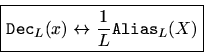
Decimation Theorem (Aliasing Theorem)
Theorem: For all,
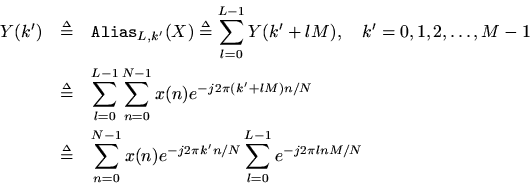
Proof: Let
denote the frequency index in the aliased spectrum, and let
. Then
is length
, where
is the decimation factor. We have
Since, the sum over
becomes
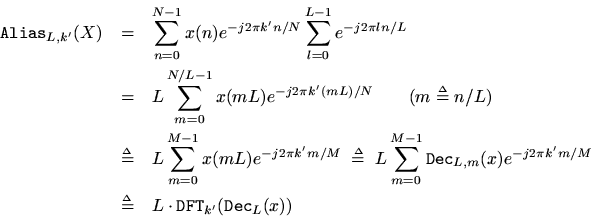
using the closed form expression for a geometric series derived earlier. We see that the sum overevery
which ranges only over the nonzero samples:
Since the above derivation also works in reverse, the theorem is proved.Here is an illustration of the Decimation Theorem in Matlab:
>> N=4; >> x = 1:N; >> X = fft(x); >> x2 = x(1:2:N); >> fft(x2) % FFT(Decimate(x,2))
ans =4 -2
>> (X(1:N/2) + X(N/2 + 1:N))/2 % (1/2) Alias(X,2)
ans =4.0000 -2.0000</pre></p><p>An illustration of aliasing in the frequency domain is shown in
Fig. 8.10.
<< Previous page TOC INDEX Next page >>