
NOTE: THIS DOCUMENT IS OBSOLETE, PLEASE CHECK THE NEW VERSION: "Mathematics of the Discrete Fourier Transform (DFT), with Audio Applications --- Second Edition", by Julius O. Smith III, W3K Publishing, 2007, ISBN 978-0-9745607-4-8. - Copyright © 2017-09-28 by Julius O. Smith III - Center for Computer Research in Music and Acoustics (CCRMA), Stanford University
<< Previous page TOC INDEX Next page >>
Even and Odd Functions
Some of the Fourier theorems can be succinctly expressed in terms of even and odd symmetries.
Definition: A functionis said to be even if
. An even function is alsosymmetric, but the term symmetric applies also to functions symmetric about a point other than
.
Definition: A function. An odd function is also calledantisymmetric.
Note that every odd function
. Moreover, for any
with
even, we also have
since
, i.e.,
and
index the same point.
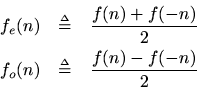
Theorem: Every functionand odd part
, where
Proof: In the above definitions,
is even and
is odd by construction. Summing, we have
Theorem: The product of even functions is even, the product of odd functions is even, and the product of an even times an odd function is odd.Proof: Readily shown.
Since even times even is even, odd times odd is even, and even times odd is odd, we can think of even as
and odd as
:
,
, and
.
Example:is an even signal since
.
Example:is an odd signal since
.
Example:is odd (even times odd).
Example:is even (odd times odd).
Theorem: The sum of all the samples of an odd signalin
is zero.
Proof: This is readily shown by writing the sum as
, where the last term only occurs when
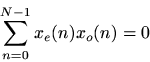
Example: For all DFT sinusoidal frequencies,
More generally,
for any even signaland odd signal