
NOTE: THIS DOCUMENT IS OBSOLETE, PLEASE CHECK THE NEW VERSION: "Mathematics of the Discrete Fourier Transform (DFT), with Audio Applications --- Second Edition", by Julius O. Smith III, W3K Publishing, 2007, ISBN 978-0-9745607-4-8. - Copyright © 2017-09-28 by Julius O. Smith III - Center for Computer Research in Music and Acoustics (CCRMA), Stanford University
<< Previous page TOC INDEX Next page >>
Modulo Indexing, Periodic Extension
The DFT sinusoids
are all periodichaving periods which divide
. That is,
for any integer
. Since a length
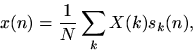
can be expressed as a linear combination of the DFT sinusoids in the time domain,
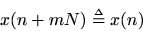
it follows that the ''automatic'' definition ofbeyond the range
is periodic extension, i.e.,
for every integer
Moreover, the DFT also repeats naturally every
because. (The DFT sinusoids behave identically as functions of
and
.) Accordingly, for purposes of DFT studies, we may define allsignals in
as being single periods from an infinitely long periodic signal with period
Definition: For any signal, we define
for every integerAs a result of this convention, all indexing of signals and spectra8.1 can be interpreted modulo
to emphasize this. Formally, ''
'' is defined as
with
As an example, when indexing a spectrum
, we have that
which can be interpreted physically as saying that the sampling rate is the samefrequency as dc for discrete time signals. In the time domain, we have what is sometimes called the ''periodic extension'' of
seconds (
.
It is also possible to adopt the point of view that the time-domain signal
interpolation'' below).