
NOTE: THIS DOCUMENT IS OBSOLETE, PLEASE CHECK THE NEW VERSION: "Mathematics of the Discrete Fourier Transform (DFT), with Audio Applications --- Second Edition", by Julius O. Smith III, W3K Publishing, 2007, ISBN 978-0-9745607-4-8. - Copyright © 2017-09-28 by Julius O. Smith III - Center for Computer Research in Music and Acoustics (CCRMA), Stanford University
<< Previous page TOC INDEX Next page >>
Other Norms
Since our main norm is the square root of a sum of squares, we are using what is called an
norm and we may write
to emphasize this fact.
We could equally well have chosen a normalized
which is simply the ''RMS level'' of.
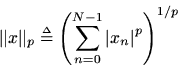
More generally, the
norm of
is defined
The most interestingNote that the case
: The
, ''absolute value,'' or ''city block'' norm.
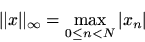
: The
: The
, ''Chebyshev,'' ''supremum,'' ''minimax,'' or ''uniform'' norm.
There are many other possible choices of norm. To qualify as a norm on
, a real-valued signal function
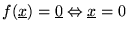
must satisfy the following three properties:
The first property, ''positivity,'' says only the zero vector has norm zero. The second property is ''subadditivity'' and is sometimes called the ''triangle inequality'' for reasons which can be seen by studying Fig. 6.3. The third property says the norm is ''absolutely homogeneous'' with respect to scalar multiplication (which can be complex, in which case the phase of the scalar has no effect).
,
Mathematically, what we are working with so far is called a Banach space which a normed linear vector space. To summarize, we defined our vectors as any list of
real or complex numbers which we interpret as coordinates in the
and
from the vector space, and given any two scalars
and
from the field of scalars, then any linear combination
must also be in the space. Since we have used the field of complex numbers
(or real numbers
) to define both our scalars and our vector components, we have the necessary closure properties so that any linear combination of vectors from