
NOTE: THIS DOCUMENT IS OBSOLETE, PLEASE CHECK THE NEW VERSION: "Mathematics of the Discrete Fourier Transform (DFT), with Audio Applications --- Second Edition", by Julius O. Smith III, W3K Publishing, 2007, ISBN 978-0-9745607-4-8. - Copyright © 2017-09-28 by Julius O. Smith III - Center for Computer Research in Music and Acoustics (CCRMA), Stanford University
<< Previous page TOC INDEX Next page >>
Shannon's Sampling TheoremTheorem. Let
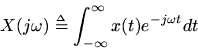
denote any continuous-time signal having a continuous Fourier transform
Let
denote the samples ofseconds. Then
if and only if
for all
.A.1
Proof. From the Continuous-Time Aliasing Theorem of §A.2, we have that the discrete-time spectrum
can be written in terms of the continuous-time spectrum
as
whereis the ''digital frequency'' variable. If
, then the above infinite sum reduces to one term, the
term, and we have
At this point, we can see that the spectrum of the sampled signalcoincides with the spectrum of the continuous-time signal
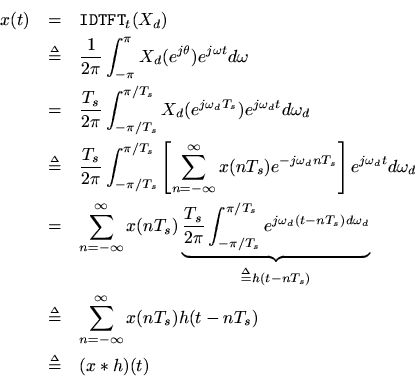
To reconstruct
By expanding, the formula for reconstructing
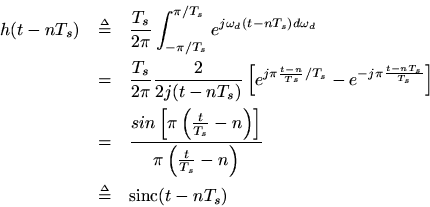
where we defined
I.e.,
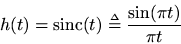
The ''sinc function'' is defined within its argument so that it has zero crossings on the integers, and its peak magnitude is 1. Figure A.2illustrates the appearance of the sinc function.
We have shown that when
Conversely, if
, it must be true that
, since a sampled signal only supports frequencies up to
(see §A.4). This completes the proof of Shannon's Sampling Theorem.
A ''one-line summary of Shannon's sampling theorem is as follows:
That is, the Discrete-Time Fourier Transform of the samples is extended to plus and minus infinity by zero, and the inverse Fourier transform of that gives the original signal. The Continuous-TimeAliasing Theorem provides that the zero-paddedand
are identical, as needed.
Shannon's sampling theorem is easier to show when applied todiscrete-time sampling-rate conversion, i.e., when simple decimationof a discrete time signal is being used to reduce the sampling rate by an integer factor. In analogy with the Continuous-Time Aliasing Theorem of §A.2, the Decimation Theorem states thatdownsampling a digital signal by an integer factor
produces a digital signal whose spectrum can be calculated by partitioning the original spectrum into