Elementary Digital Filter Theory


<< Previous page  TOC  INDEX  Next page >>

Relation to Schur Functions

Definition. A Schur function $S(z)$is defined as a complex function analytic and of modulus not exceeding unity in $\.

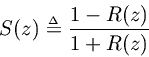
Theorem. The function

\

is a Schur function if and only if $R(z)$ is positive real.

Proof.

Suppose $R(z)$ is positive real. Then for $\, $\ is PR. Consequently, $1+R(z)$is minimum phase which implies all roots of $S(z)$ lie in the unit circle. Thus $S(z)$ is analytic in $\. Also,

\

By the maxmimum modulus theorem, $S(z)$ takes on its maximum value in $\on the boundary. Thus $S(z)$ is Schur.

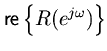
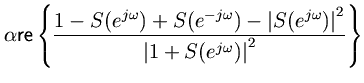
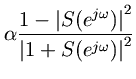
Conversely, suppose $S(z)$ is Schur. Solving Eq. (1.2) for $R(z)$and taking the real part on the unit circle yields

$\$\$\(33)
$\$\$\(34)
 $\$\(35)
 $\$\(36)
 $\$\(37)

If $S(z)=\ is constant, then $R(z)=(1-\ is PR. If $S(z)$ is not constant, then by the maximum principle, $S(z)<1$ for $\. By Rouche's theorem applied on a circle of radius $1+\, $\, on which $\, the function $1+S(z)$ has the same number of zeros as the function $1$ in $\. Hence, $1+S(z)$ is minimum phase which implies $R(z)$ is analytic for $z\. Thus$R(z)$ is PR.$\

<< Previous page  TOC  INDEX  Next page >>

Back to Hardware Guides
Copyright © 2000-09-19 by Julius O. Smith III, Adpated from Techniques for Digital FilterDesign and System Identification, with Application to the Violin, Julius O. Smith III, Ph.D. Dissertation, CCRMA, Department of Electrical Engineering, Stanford University, June 1983.. This is an original HTML version reproduced by permission.
| TXT | TXT+
Unless otherwise indicated, the contents of this site are copyright © Nicola Asuni - Tecnick.com s.r.l.
Tecnick.com s.r.l. - Sede Legale: Via Della Pace, 11 – 09044 – Quartucciu (CA) – ITALY - Capitale Sociale € 10.000,00 i.v. - P. IVA e C.F.: 02574420929 - C.C.I.A.A.: CA-2000-19195 - R.E.A.: 208980

Powered by Tecnick.com AIOCP (All In One Control Panel) GetJava Download Button
 
Technick.net - Tons of Hardware Information


Bookmark and Share